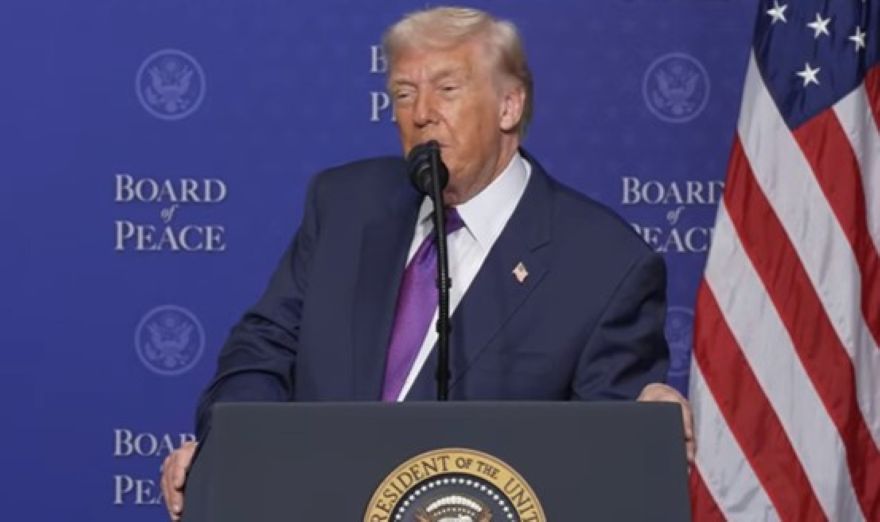
President Donald Trump declared on Thursday a landmark agreement for the complete disarmament of Hamas and all armed groups in Gaza—hailing it as a monumental step toward lasting peace under his Board of Peace initiative.
Neither Israel nor the militant group has formally confirmed the deal.
In a Truth Social post, Trump announced: “Today, the Board of Peace reached a HISTORIC agreement for the COMPLETE DISARMAMENT of Hamas and all other armed groups in Gaza. This is a monumental step toward lasting PEACE and SECURITY.”
Under the carefully phased framework of the Trump 20-Point Plan, the agreement envisions Hamas surrendering its heavy weapons and dismantling its vast tunnel network, followed by a gradual withdrawal of Israeli forces.
In their place, a new International Stabilization Force would partner with a new Palestinian police force to secure the territory, while a technocratic Palestinian government assumes civilian control.
Today, the Board of Peace reached a HISTORIC agreement for the COMPLETE DISARMAMENT of Hamas and all other armed groups in Gaza.
A monumental step toward lasting PEACE and SECURITY. pic.twitter.com/RYUKUdrwIJ
— The White House (@WhiteHouse) July 30, 2026
The White House cast the development as a historic milestone, with the President asserting that Gaza will “finally be in the hands of a new Palestinian government that serves its people” and vowing that the threat of October 7 “will NOT be allowed to rebuild.”
“This agreement is a critical step towards Gaza finally being governed by a new Palestinian government that will work closely with the Board of Peace to help the Palestinian people. At the same time, Israel will have the security it deserves, with Gaza no longer used as a base for terror attacks,” Trump noted in the post.
A Gaza police force—which excludes most Hamas militants—is expected to turn over light weapons within two weeks, the surrender of heavy armaments, including rockets and anti-tank missiles, alongside the decommissioning of tunnels, could take anywhere from 200 to 350 days.
What will it take to rebuild Gaza? Costs, timelines, and challenges
Israel, which has been deeply skeptical of Hamas’s willingness to relinquish its arsenal or cede control of Gaza, has been consulted but not formally assented to the new terms.
A U.S. official, cited by AP, warned that Trump would be “very, very disappointed” if Israel does not adhere, though the Israeli government declined immediate comment.
The agreement arrives at a precarious moment: ceasefire negotiations have largely deadlocked for months, military attacks have escalated, and Iran—a key Hamas backer—remains distracted by its own conflict with the United States but still capable of influencing the group’s calculus.
The conflict was triggered by the Hamas-led assault on southern Israel on October 7, 2023, which resulted in approximately 1,200 Israeli deaths and the abduction of 251 hostages. Israel’s subsequent military campaign in Gaza has killed over 73,000 Palestinians, according to Gaza’s Health Ministry, a figure that includes casualties sustained since the ceasefire took effect.
Hamas, whose founding charter enshrines armed resistance, has previously insisted on completing the first phase of the ceasefire before discussing disarmament, and while it recently dissolved its Gaza government in a symbolic gesture, its ultimate commitment to giving up the weapons at the heart of its identity remains unproven.
For the President, who thanked mediators Egypt, Qatar, and Türkiye alongside his own team, the announcement is a crowning achievement—a deal “everybody said could never be achieved.”
The people of Gaza and Israel alike, however, still wait to see a clear path from this declaration to lead to durable peace.

Iftikhar Ali is a veteran Pakistani journalist, former president of UN Correspondents Association, and a recipient of the Pride of Performance civil award