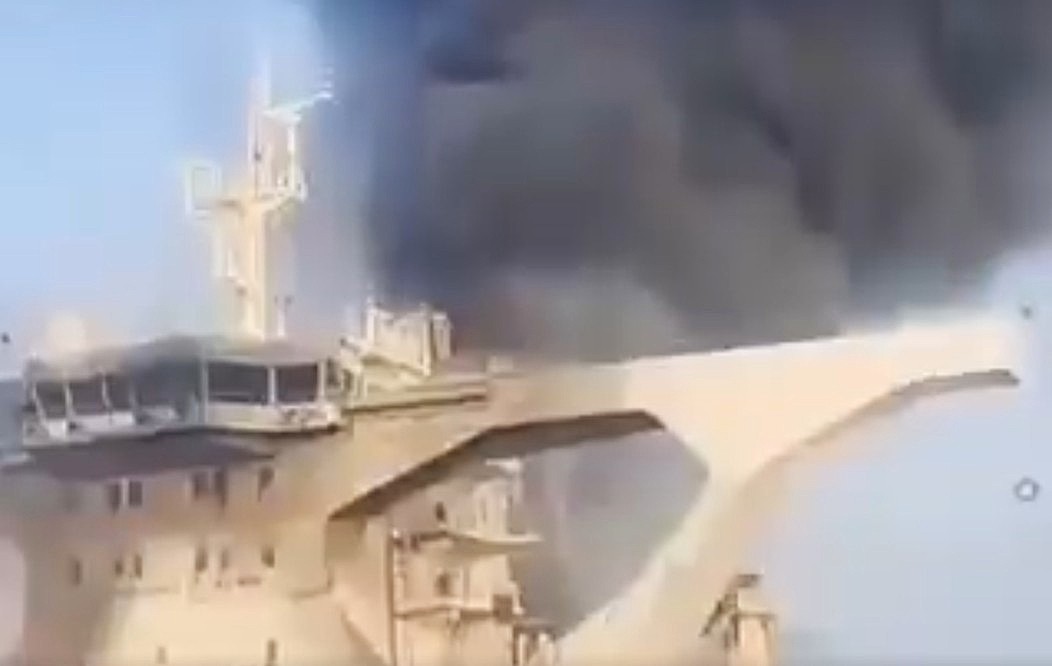
A Qatari liquefied natural gas (LNG) carrier destined for Pakistan was struck by unidentified objects in the Arabian Gulf on Friday, despite reported Iranian approval for its passage through the Strait of Hormuz, raising concerns over the security of energy shipments to the South Asian country.
The Marshall Islands-flagged vessel, Al Mayeda, was carrying LNG from Qatar when it came under attack on October 30. Pakistan had reportedly negotiated with Iranian officials to arrange safe passage for the tanker, with Tehran giving its approval only hours before the incident.
The vessel subsequently changed direction and headed back into the Persian Gulf, according to ship-tracking data, leaving uncertainty over whether its cargo will reach Pakistan.
Indian Shipping Minister Sarbananda Sonowal said the tanker had been targeted in a projectile attack. All 25 crew members, including six Indian nationals, were reported safe.
The LNG tanker hit in the Gulf on Friday had just hours before received approval from Iran to transit Hormuz 🚢 ⚠️
Pakistan had negotiated safe passage with Iran, as the South Asian country had done several times previously. The tanker was carrying LNG from Qatar
https://t.co/LneGRz2DQE
— Stephen Stapczynski (@SStapczynski) November 1, 2026
Qatar Gas Transport Company, known as Nakilat, confirmed on Sunday that its LNG carrier had been struck by unidentified objects while sailing in the Arabian Gulf. The company said nobody aboard was injured, no environmental damage had been reported and the vessel remained operational. An assessment of the impact was continuing.
Qatar’s Foreign Ministry condemned the incident, describing it as a threat to maritime navigation and international energy security. Doha said an investigation had been initiated to establish the circumstances surrounding the attack and identify those responsible. It also reserved the right to take necessary measures under international law to protect its vessels, assets and crews.
The incident prompted criticism from other Gulf countries, with Saudi Arabia and the United Arab Emirates joining Qatar in condemning the attack. Riyadh called for international action to protect commercial shipping and global energy supplies, while Abu Dhabi expressed solidarity with Doha and warned of the potential consequences for maritime security and regional stability.
The Gulf Cooperation Council also condemned the targeting of the LNG carrier, warning that attacks on energy shipments could threaten maritime trade, disrupt energy flows and undermine regional economic stability.
Statement | Qatar Condemns Attack on LNG Carrier in Arabian Gulf
Doha | November 1, 2026
The State of Qatar expresses its strong condemnation and denunciation of the attack that targeted “Al Mayeda” liquefied natural gas (LNG) carrier, owned by Qatar Gas Transport Company Limited (Nakilat), while it was sailing in the Arabian Gulf. Qatar considers this a dangerous act that threatens the safety of maritime navigation and the security of global energy supplies.
The Ministry of Foreign Affairs affirms that the State of Qatar reserves its right to take all necessary measures, in accordance with international law and the UN Charter, to protect its assets and safeguard its vessels and their crews. The Ministry points out that the relevant authorities have initiated the necessary investigations to determine the circumstances of the incident and identify those responsible.
The Ministry of Foreign Affairs also warns against the dangers of such reckless and irresponsible actions, and the grave repercussions they may have on regional security and stability, as well as the global economy – particularly the potential environmental risks resulting from the targeting of energy carriers, and the serious consequences for the marine environment and the water security of the countries in the region.
#MOFAQatar
— Ministry of Foreign Affairs – Qatar (@MofaQatar_EN) November 1, 2026
Pakistan, meanwhile, has yet to issue a publicly reported formal statement specifically addressing the attack. Pakistani authorities have also made no definitive public announcement about whether a replacement LNG shipment will be arranged or whether the incident will affect domestic gas supplies.
It remains uncertain whether Al Mayeda will resume its journey or whether the LNG shipment will be delivered to Pakistan.
The latest attack could complicate Pakistan’s efforts to maintain energy supplies amid prolonged disruptions to LNG shipments from the Gulf. The country depends heavily on Qatari imports to meet requirements across its power generation, industrial and domestic sectors.
Qatar supplied approximately 4.5 million tons of LNG to Pakistan in 2025, accounting for nearly all of the country’s LNG imports, according to World Bank data cited by Radio Free Europe/Radio Liberty.
A delayed or cancelled delivery could force Islamabad to explore alternative supplies, including purchases on the international spot market, where LNG prices have climbed sharply. Bloomberg reported that replacement cargoes could cost more than three times their pre-war levels.
A Pakistani energy ministry official separately told Arab News in October that spot-market LNG was trading at around $30 to $35 per million British thermal units (MMBtu), compared with $12 to $15 under the country’s long-term supply arrangements with Qatar.
Shipping through the Strait of Hormuz has remained significantly below pre-conflict levels despite a gradual resumption of some LNG movements. Data from S&P Global Energy showed that 19 LNG cargoes crossed the waterway in September, including 13 from Qatar and six from the United Arab Emirates. Kpler recorded 21 shipments during the same month.
The September increase marked the highest monthly volume since the conflict began, although analysts warned that continued security risks could constrain further recovery in regional LNG trade.
The tanker incident also comes as Qatar continues diplomatic efforts to help resolve the wider regional conflict. Iranian and Qatari officials held discussions in Doha in recent days as part of diplomatic efforts concerning the conflict involving Iran, the United States and Israel, although no agreement had been announced.
The attack has added another layer of uncertainty to LNG trade through one of the world’s most strategically important maritime corridors, with Pakistan’s energy-import requirements particularly exposed to any prolonged disruption.

Muhammad Luqman is Associate Editor at Views News Now. He writes on wide-ranging issues including economy, South Asia, the Middle East, agriculture, economy and innovation. Luqman has worked some of the leading news organizations and won acclaim for his original and research-based works.