
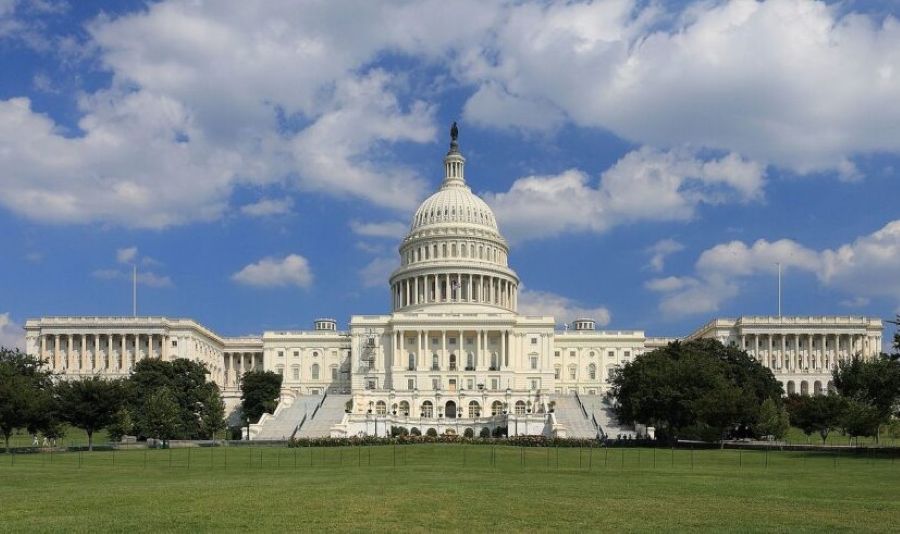
Americans head to the polls on Tuesday in midterm elections that could reshape the balance of power in Washington, determining whether President Donald Trump retains a Republican-controlled Congress or faces a Democratic majority capable of obstructing his legislative agenda, scrutinising his administration and challenging its spending priorities.
All 435 seats in the House of Representatives and 35 Senate seats are being contested. Republicans currently hold narrow majorities in both chambers, leaving Democrats with an opportunity to regain control of Congress and provide a check on Trump’s presidency during the second half of his term.
Democrats need a net gain of three seats to take control of the House, where Republicans hold 218 seats against 214 for Democrats, with two vacancies and one independent member who generally supports the Republican leadership. In the Senate, Republicans hold 53 seats, while Democrats and two independents who caucus with them have a combined 47. Democrats need a net gain of four seats to secure a majority.
The midterm elections, held every four years halfway through a president’s term, are traditionally viewed as a referendum on the incumbent administration. This year’s contests carry particular significance as voters weigh the economy, the administration’s immigration policies, the war with Iran and the direction of American foreign policy.
Democrats Hold Edge in Key Senate Battlegrounds, Final Polls Show https://t.co/H6r08i7v0n via @ViewsNewsNow
— Views&News (@ViewsNewsMag) November 2, 2026
The political climate has been challenging for Trump. A Pew Research Center survey conducted between September 28 and October 4 found that just 30 per cent of Americans approved of his performance, while 68 per cent disapproved. The same survey found that 44 per cent of registered voters viewed their congressional vote as a vote against Trump, compared with 19 per cent who regarded it as a vote in his favor.
The survey also found an eight-point national advantage for Democratic congressional candidates, with Democrats enjoying greater voter engagement and motivation than Republicans. Forecasting models have consequently given Democrats a substantial opportunity to capture the House, while the Senate contest remains more uncertain.
More than 43 million Americans had already cast ballots through early in-person voting or returned mail ballots five days before Election Day, according to an Associated Press analysis. The early turnout was substantially ahead of the pace recorded at the same point before the 2022 midterms, although early voting figures alone do not establish which party is likely to benefit.
Trump gives up 1 day before midterms:
If the people that voted for me in the last election go out and vote, we will win in a landslide. Now, that doesn’t happen because whoever the sitting president is doesn’t win the midterms, but we gave this a very strong shot https://t.co/f6kb2MXyY3
— Headquarters (@HQNewsNow) November 2, 2026
Affordability, Iran war and immigration dominate debate
The cost of living has emerged as the most consequential issue in the election campaign. Although the administration has highlighted its economic policies and tax measures, many households remain concerned about the cost of groceries, housing, healthcare, electricity and fuel. Rising energy prices have added to the pressure, leaving voters questioning whether economic growth and government policies are translating into tangible improvements in their daily lives.
A Pew Research Center survey found that 84 per cent of registered voters considered the economy very important to their midterm vote. Gallup’s October survey likewise placed the economy and healthcare at the top of voters’ priorities, with half of registered voters describing each as extremely important. The economic debate is therefore not simply about inflation figures or employment statistics, but about purchasing power, household security and whether families can afford essential expenses.
Donald Trump said Washington was in no hurry to strike a deal with Iran and declined to say whether he expected the US to go back to war with Tehran after the midterm elections https://t.co/tjEgi5BGzT https://t.co/7zEQVpNmQ7
— Reuters (@Reuters) November 1, 2026
The war with Iran has added another major dimension to the campaign. Its consequences for energy supplies, fuel prices, regional stability and America’s international commitments have made foreign policy a domestic electoral issue. According to Gallup’s October survey, 47 per cent of registered voters considered the situation in Iran extremely important to their vote, placing it among the leading issues in the election. The conflict has also intensified questions about the costs of American military involvement, the administration’s objectives and the prospects for a diplomatic settlement.
Immigration enforcement is another major dividing line. Trump’s administration has pursued an aggressive campaign of arrests and deportations, defending it as necessary to secure the border and enforce immigration laws. Critics, however, have raised concerns about the treatment of migrants, family separations, detention conditions, due process and the impact of enforcement operations on immigrant communities. While many Republican voters favour tougher enforcement, polling indicates considerable public concern about how these policies are being implemented. A Pew survey found that 59 per cent of registered voters considered immigration very important to their congressional vote, with the issue particularly prominent among Republican supporters.

Muhammad Luqman is Associate Editor at Views News Now. He writes on wide-ranging issues including economy, South Asia, the Middle East, agriculture, economy and innovation. Luqman has worked some of the leading news organizations and won acclaim for his original and research-based works.









