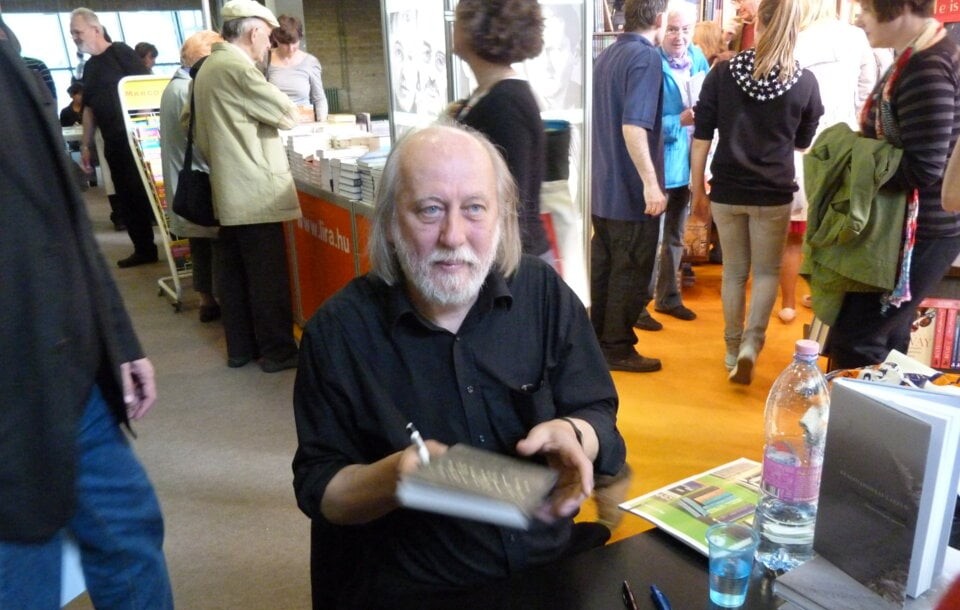
For his “compelling and visionary oeuvre that, in the midst of apocalyptic terror, reaffirms the power of art,” the 2025 Nobel Prize in Literature has been awarded to László Krasznahorkai, one of Europe’s most enigmatic and genre-defying novelists.
Born in 1954 in the quiet town of Gyula near Hungary’s Romanian border, Krasznahorkai has forged a literary path defined by haunting intensity, philosophical depth, and linguistic audacity.
His stories often unfold in desolate, often crumbling landscapes—real and imagined—where hope flickers amid chaos, and beauty endures despite the end times looming just out of frame.
Krasznahorkai is a “great epic writer in the Central European tradition that extends through Kafka to Thomas Bernhard, and is characterised by absurdism and grotesque excess. But there are more strings to his bow, and he also looks to the East in adopting a more contemplative, finely calibrated tone,” the Nobel organization said.
The transformative power of Literature, opinion piece by Valda Fogaca
His breakthrough came with Sátántangó (1985; Satantango, 2012), a bleakly hypnotic tale set on a decaying Hungarian collective farm, where villagers await the return of a supposed savior—or conman—who may lead them to salvation or ruin. The novel, with its dense, spiraling prose and sense of spiritual dread, became an instant sensation in Hungary and later gained global cult status, especially after its epic film adaptation by Béla Tarr.
American critic Susan Sontag dubbed Krasznahorkai the “master of the apocalypse” after reading his second novel, The Melancholy of Resistance (1989). In this surreal and prophetic work, a ghostly circus dragging a giant dead whale into a sleepy Hungarian town triggers social collapse and creeping authoritarianism. It is a fever dream of fear and futility that blurs the line between the grotesque and the sublime.
Krasznahorkai’s novels form a body of work where long, flowing sentences mimic the overwhelming flood of thought and dread. In War & War (1999), a troubled archivist travels from Budapest to New York to publish a mysterious ancient manuscript, believing it holds humanity’s lost truth. In Baron Wenckheim’s Homecoming (2016), a faded aristocrat returns from exile to a hometown that no longer resembles the one he remembers, becoming the unwitting center of a farcical and tragic civic spectacle.
His most recent epic, Herscht 07769 (2021; English, 2024), transposes his vision of societal disintegration to a modern German town wracked by violence, where the spirit of Bach hovers over an otherwise chaotic world. Here again, Krasznahorkai fuses historical weight with contemporary anxiety, crafting a narrative of betrayal, gullibility, and misplaced faith.
Yet his work also turns eastward, toward spiritual contemplation and artistic transcendence. Seiobo There Below (2008) is a profound meditation on beauty and the creative process, structured through a Fibonacci sequence and set across cultures and centuries—from Kyoto’s temples to Renaissance Italy. In these stories, artists are often absent, and their work is realized by those who may never understand its full meaning. The result is a powerful reflection on the invisible forces behind artistic creation.
His Eastern-inspired novel A Mountain to the North, a Lake to the South… (2003) further reflects this shift, offering a lyrical, meditative journey through the landscapes of Kyoto and the soul.
Even in his more playful moments, Krasznahorkai retains his signature depth. Spadework for a Palace (2020) is a wildly eccentric tale set in Manhattan, haunted by Herman Melville’s ghost and the madness of literary obsession. It’s a darkly comic take on genius, imitation, and the fine line between reverence and insanity.
With this Nobel recognition, Krasznahorkai is affirmed not only as one of Central Europe’s greatest living writers but as a visionary chronicler of our most existential fears and fragile hopes. His work, steeped in philosophical and moral complexity, continues to echo Kafka, Dostoyevsky, and Bernhard—yet stands entirely in its own towering, spiraling realm.
Follow for more: Twitter (X) | Facebook | Instagram | LinkeIn

Kiran Asim is a writer who covers the U.S., Europe, South Asia, and the Middle East. Her reports and analyses look at the geostrategic issues and contemporary developments and their economic and political implications. She also writes about society and education.