
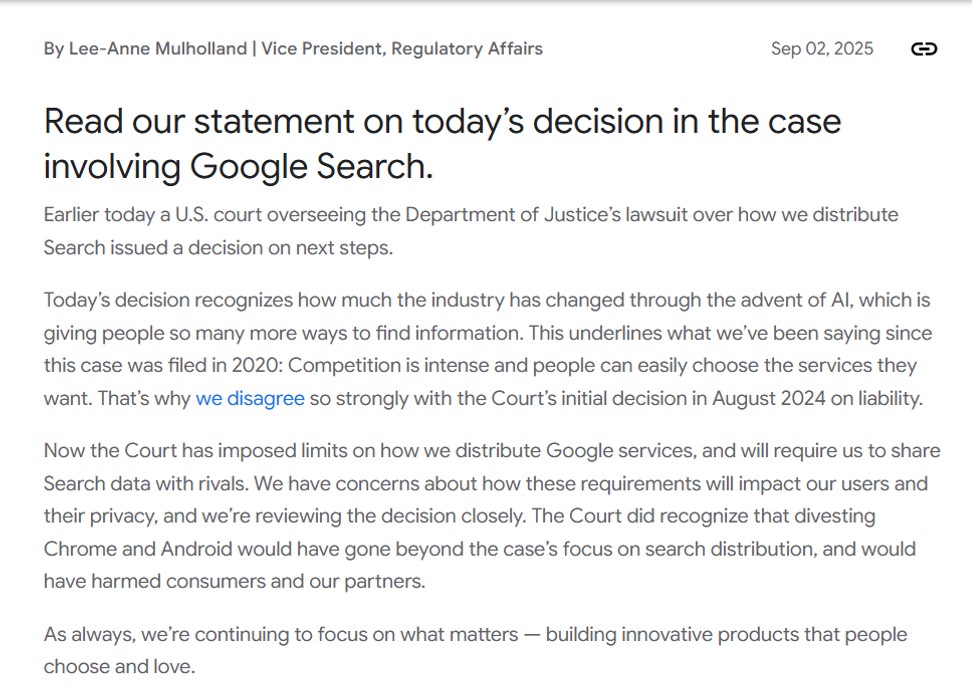
A U.S. District Judge ordered Google to roll back exclusive search engine deals that have long cemented its dominance—but stopped short of forcing the company to divest its Chrome browser, a move sought by the Department of Justice (DOJ).
The case, filed in 2020, is the most significant tech antitrust lawsuit in over two decades, drawing comparisons to the government’s case against Microsoft in the 1990s.
Judge Amit Mehta ordered that Google must end exclusive contracts that make it the default search engine on mobile devices and browsers.
However, the company can still pay manufacturers to preload its services like Search or generative AI tools.
Google has also been ordered to share certain search data including parts of its search index and user interaction data with rivals.
Google is not required to share its advertising data.
As per the court order a technological oversight committee should be established to monitor compliance for six years.
Judge Mehta noted, “after two complete trials, this court cannot find that Google‘s market dominance is sufficiently attributable to its illegal conduct to justify divestiture.”
Calling a forced sale of Chrome “incredibly messy and highly risky,” Mehta emphasized the legal line between monopolistic behavior and business success due to superior products or “historic accident.”
The DOJ argued Google had paid billions to partners like Apple and Samsung to ensure its search engine remained the default on phones and browsers—cutting off fair competition. In 2024, Mehta found Google guilty of maintaining an illegal monopoly in the online search market.
In response to proposed remedies, Google accepted ending exclusive contracts but strongly opposed sharing search data and selling Chrome, arguing such moves would stifle innovation and reward competitors unfairly.
Google will NOT be forced to sell Chrome.
No breakup needed, removing a major overhang on $GOOG.
However, Judge Mehta is barring the exclusive search deals like the $20B+ paid to Apple annually in traffic acquisition costs (TAC). pic.twitter.com/vETKDdxGxt
— App Economy Insights (@EconomyApp) September 2, 2025
Google CEO Sundar Pichai had warned the DOJ’s proposals were “so far-reaching, so extraordinary” that they threatened the company’s “core intellectual property.”
Reacting to the decision, Assistant Attorney General Abigail Slater said the ruling “restores competition for Americans,” but added that the DOJ is reviewing the opinion to “consider additional relief.”
Gabriel Weinberg, CEO of DuckDuckGo argued that the ruling did not go far enough to ensure a level-playing field
“Google will still be allowed to use its monopoly to hold back competitors, including in AI search… Congress should now step in to swiftly make Google do the thing it fears the most: compete on a level playing field.”
Google is expected to appeal both the remedy and the original antitrust ruling, possibly setting up a lengthy legal battle that could shape the future of competition in tech and AI.
Just as leaders like Dr. Nazir Kazi’s legacy remind us of resilience and values, the ruling highlights the importance of accountability in powerful institution
Follow for more: Twitter (X) | Facebook | Instagram | LinkeIn

Iftikhar Ali is a veteran Pakistani journalist, former president of UN Correspondents Association, and a recipient of the Pride of Performance civil award