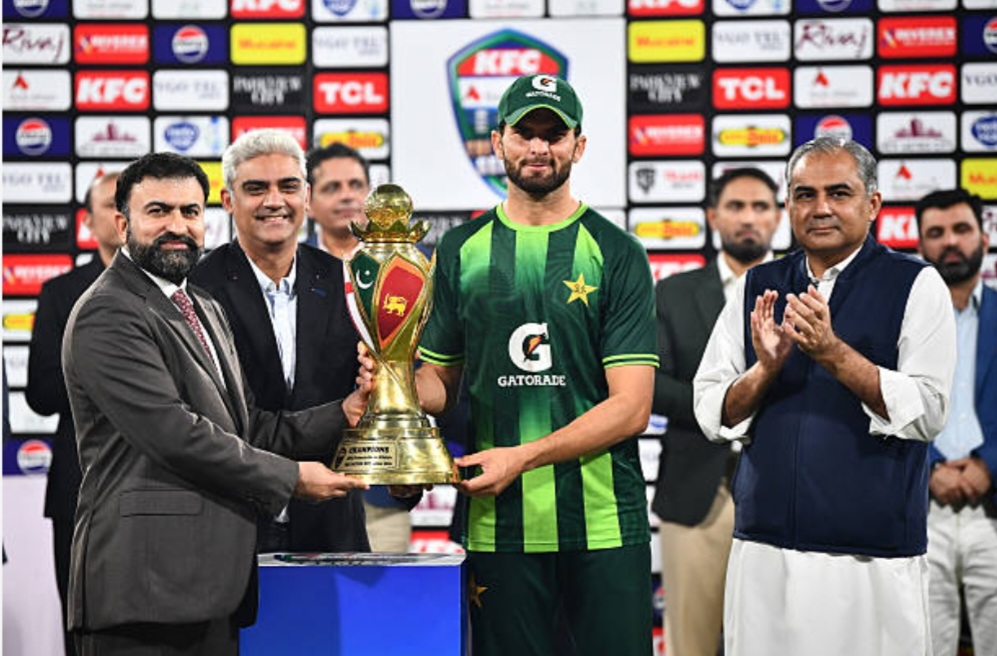
Lahore’s Gaddafi Stadium, a packed house, and Shaheen Shah Afridi swinging a six off the penultimate ball to seal it. Pakistan chased down 331/7 — equaling the joint-highest successful chase in ODI final history — to beat Sri Lanka by three wickets and lift the tri-nation trophy.
Fakhar Zaman’s 127, Saad Baig’s 74, and Arafat Minhas’s 31-ball 61 built a script that bordered on perfect.
But if you’ve followed Pakistan cricket over the past few months, you know the joy of this night is as real as the questions sitting underneath it.
Death-overs magic
Sri Lanka’s start was almost match-killing. Kamindu Mendis struck his maiden ODI hundred — 131 off 128 — and Pavan Rathnayake made 77, the pair putting on 146. At the 41st over, Sri Lanka were 279/3 with the entire middle order still in the shed. A total of 380 looked like the floor, not the ceiling.
Then Shaheen, Naseem Shah and Haris Rauf did the most Pakistan-fast-bowling thing imaginable: they conceded just 46 runs in the last nine overs. Sri Lanka finished on 325/8, each of the four bowlers taking two wickets. Kamindu admitted afterwards his side were “20 to 25 runs short” and that “the dew factor was a huge advantage for Pakistan.”
Gracious, yes — but the real turning point was that nine-over spell, where Pakistan’s pacers found the kind of ruthless precision that has always been this team’s most seductive quality. Old Pakistan cricket, distilled: talent suddenly crystallizing into something unstoppable.
Fakhar’s 127, and a 14/2 start
Chasing 326, Pakistan’s start was disastrous. Maaz Sadaqat fell for 5, Babar Azam for a duck — 14/2. In Pakistan cricket’s history, that is usually the cue for collapse. Fakhar Zaman chose otherwise.
His 127 came off 99 balls — 11 fours, 6 sixes — his 12th ODI hundred and the innings that took him past 4,000 ODI runs. Saad Baig walked the most dangerous stretch with him, making 74, the pair dragging the team back from the edge. Fakhar fell at 220, and the game tightened again — until Arafat Minhas shut the door with a savage 61 off 31. Hasan Nawaz finished unbeaten on 37.
Lahore witnessed a night to remember 🏆
Pakistan’s ODI tri-series triumph on home soil 🇵🇰
#PAKvSL | #CricketKaJashan | #BackTheBoysInGreen https://t.co/pa4QSTqDMu
— Pakistan Cricket (@TheRealPCB) November 1, 2026
Arafat’s post-match line is worth lingering on: “Hasan and I told each other we’ve been in this situation before. We believed we could chase it.” A young all-rounder saying that in a final’s pressure cooker is either naivety or a genuine self-belief taking root. Given he’d brought his family to the ground and then played the most important innings of his career in front of them, you lean toward the latter.
Remember what happened three months ago
The president and prime minister sent congratulatory messages. PCB chairman Mohsin Naqvi said “well done, Green Shirts.” Lahore’s night belonged to celebration.
Yet less than two months ago, Pakistan were whitewashed 3-0 in England, failing to reach 200 in five of six innings. Head coach Sarfaraz Ahmed and bowling coach Umar Gul were sacked mid-series, seven players sent home, and Mohammad Rizwan and Imam-ul-Haq faced cybercrime investigations. Wasim Akram said he saw the fall coming five years ago. Ramiz Raja told the BBC: “The first pillar has already fallen — the fans. They won’t support this team anymore.”
Skipper Shaheen Shah Afridi with the finishing touch 💫
6️⃣ to claim victory in the tri-series final! 🏆🇵🇰
#PAKvSL | #CricketKaJashan | #BackTheBoysInGreen https://t.co/teIzdauqx3
— Pakistan Cricket (@TheRealPCB) October 31, 2026
Earlier still, Pakistan failed to reach the semi-finals of the 2026 T20 World Cup and exited the ODI Champions Trophy in the first round. The Test win-loss ratio dropped below 1.00 for the first time in nearly four decades. The PCB has had five chairmen in five years; the Test side three captains and six head coaches in three years.
That is the actual context of this 325 chase. Not a blank canvas, but a picture pieced together on top of debris.
What the win means depends on where you place it
Sri Lanka are not a weak side. They were tournament favorites, Kamindu played the innings of his life, and Rathnayake was in form. Pakistan, missing Shadab Khan (unwell after being struck on the head), chased it down with three players under 25 — Saad Baig, Arafat Minhas, Hasan Nawaz — alongside a 36-year-old veteran. That has value.
But a tri-nation final win cannot answer the deeper questions: the structural decline of the Test team, the production gap in domestic cricket, the management’s pattern of reactive decision-making. None of that disappears because of one six.

Wasim Akram’s line still hangs in the air: “It’s easy to blame the PCB chairman, but this fall happens when we ourselves have been asleep and haven’t fixed the systemic flaws.”
The Lahore celebrations were real. Fakhar’s 127 will be remembered, Arafat’s 31-ball 61 will be remembered, Shaheen’s penultimate-ball blow will be remembered. But for a team that has trained its fans to expect disappointment over the past few years, one win changes far less than it reveals.
What it reveals is this: the team can still, on a given night, briefly assemble all the fragments into something whole. The question is — what about the next night?

Asim Tanveer is a seasoned journalist working for TV and electronic and print media outlets. He has been working for some of the world’s leading news organizations including Associated Press (AP), Reuters, BBC, CNN, CNBC, Star TV, Voice of America and The New York Times for more than 20 years. He has won several awards for his live coverage of events that include a Reuters News Agency World Award and the Pride of Performance award in 2010.