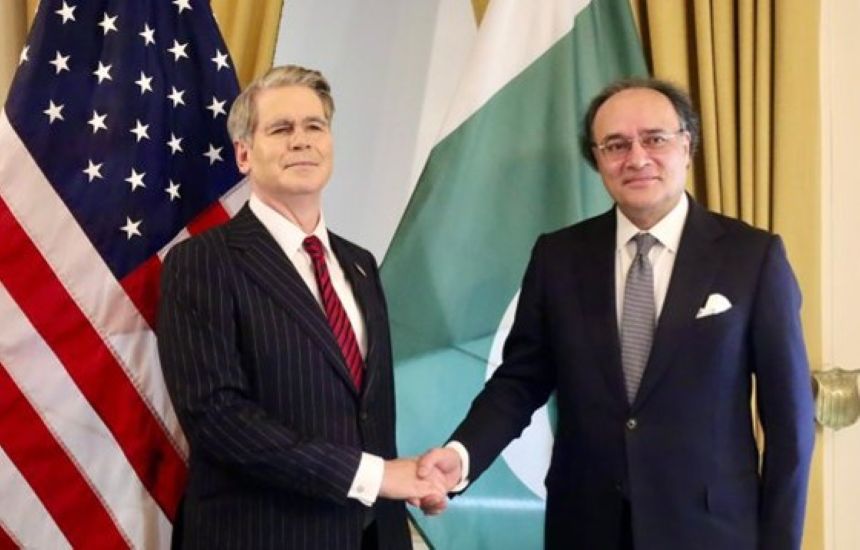
Pakistan has formally requested a $10 billion Exchange Stabilization Facility from U.S. Treasury Secretary Scott Bessent, aiming to shore up its foreign reserves and stabilize its currency, according to sources familiar with the matter.
Finance Minister Muhammad Aurangzeb made the request during recent engagements in Washington, Reuters first reported—a detail confirmed by Pakistani officials. Pakistani officials declined to elaborate, and the U.S. Treasury has not yet responded to requests for comment.
The request comes as Pakistan’s diplomatic stock rises in Washington. Islamabad’s mediation helped secure the July 17 interim peace deal between the U.S. and Iran—though that accord now risks unraveling amid fresh clashes over the Strait of Hormuz.
Separately, President Donald Trump has expressed appreciation for Pakistan as a vital counterterrorism partner, neighboring an unstable Afghanistan, which continues to be a source of concern for regional and world security.
Finance Minister Meets U.S. Treasury Secretary, Discusses Economic Cooperation and Pakistan’s Reform Agenda
Federal Minister for Finance and Revenue, Senator Muhammad Aurangzeb, met with U.S. Treasury Secretary, Mr. Scott Bessent, in Washington, D.C.
During the meeting, the… pic.twitter.com/d6ARzlzjWS
— Ministry of Finance, Government of Pakistan (@Financegovpk) July 21, 2026
The United States also regards potential as a hub for rare earth investment and invested hundreds of millions of dollars to develop its natural resource.
With unique leverage over both Tehran and Washington, Pakistan has positioned itself as an unexpected but increasingly consequential Middle East interlocutor and strategic player.
According to an official readout from Pakistan’s embassy in Washington, Finance Minister Aurangzeb requested U.S. backing for Islamabad’s “road-to-market” strategy—an effort to improve capital-market access, bolster reserves, and lift sovereign credit ratings. The statement, however, did not mention the reported $10 billion amount.
Through the Treasury’s Exchange Stabilization Fund (ESF), the facility could offer loans, currency swaps, or other backstop mechanisms to ease Pakistan’s external debt burden and curb currency volatility.
Such arrangements—distinct from the Federal Reserve’s permanent swap lines with major economies—are relatively rare and signal deep U.S. confidence in a partner’s reform trajectory.
Pakistan’s Dawn newspaper reports “strong chances” of U.S. approval, citing the Trump administration’s stated commitment to sustaining economic engagement with Islamabad.
If approved, the facility would be only the third of its kind this century. The U.S. extended a similar package to Argentina in 2025—the first since Uruguay in 2002, excluding Mexico’s standing $9 billion swap arrangement, which dates to the 1940s.

Muhammad Luqman is Associate Editor at Views News Now. He writes on wide-ranging issues including economy, South Asia, the Middle East, agriculture, economy and innovation. Luqman has worked some of the leading news organizations and won acclaim for his original and research-based works.