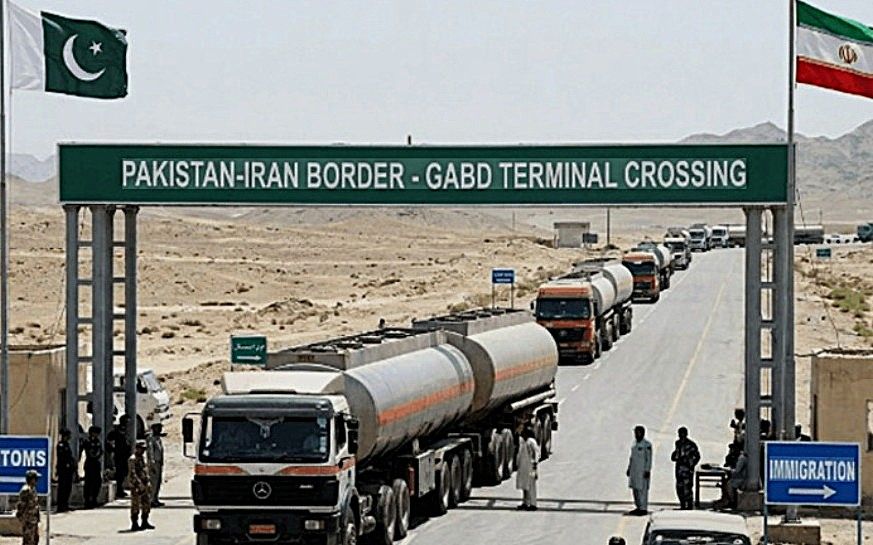
Commercial operations at the Rimdan-Gabd border crossing between Iran and Pakistan were suspended on Saturday while a separate closure of an immigration gate at another crossing left commercial consignments stranded.
Officials confirmed a halt in trade transportation via the Rimdan-Gabd border crossing, which is situated between Rimdan in Iran’s Sistan-Baluchestan province and Gabd in Pakistan’s Balochistan province.
The Rimdan-Gabd crossing links Iran’s Sistan-Baluchestan province with Pakistan’s Balochistan province. Located near the ports of Chabahar and Gwadar, it provides an important land connection between the two countries.
The measure, described as temporary, is said to be a result of a mix of factors including banking restrictions linked to U.S. sanctions against Tehran, surge in terrorism and border restrictions.
The developments follows heightened security measures and banking difficulties affecting trade with Iran.
Pakistan–Iran border closure is temporary measure to improve border management to support counterterrorism efforts. The border will be opened as soon as effective measures are in place🇵🇰 https://t.co/lagNyIbMOK
— Deputy Commissioner Chagai (@DC_Chagai) October 17, 2026
However, the reasons for the reported restrictions at the two crossings have not been publicly announced.
Pakistan’s Deputy Commissioner for Chagai district said the border closure was a temporary measure intended to improve border management and support counterterrorism efforts. The official said the crossing would reopen once effective measures were in place.
Passenger movement through Rimdan-Gabd continued without interruption, according to Iranian officials.
Seyed Hossein Hosseini, director general of the Transit Office at Iran’s Road Maintenance and Transportation Organization, confirmed the suspension of commercial operations. His statement followed several days of conflicting reports about a possible closure on the Pakistani side.
The Joint Iran-Pakistan Think Tank also verified the suspension.
Islamabad has not publicly explained the reported disruption. A Pakistani official source attributed it to banking-related sanctions, local security measures and border restrictions.
Anadolu Agency separately reported that Mohammad Hossein Bagheri had confirmed the Pakistani-side closure during a direct conversation with Pakistan’s ambassador to Tehran on Saturday morning.
Pakistan–Iran Border Measures: A Temporary, Coordinated Counterterrorism Response
▪️ Reports of a “border closure” are being selectively amplified by vested interests, including smugglers and terrorist organisations such as BLA and JuA. A temporary security measure is being turned into a controversy by those whose interests it disrupts.
▪️ The recent surge in reported terrorist activity in Iran’s Sistan-Baluchistan and Pakistan coast Guard incident is the primary trigger for these measures. Additionally need for a more robust coordinated anti smuggling mechanism and prevention illegal border trade has prompted this coordinated action to put in place effective counter measures. The Iran war has heightened security sensitivities, making effective border controls a pressing necessity.
▪️ Smugglers on both sides are crying foul. Fabricated letters attributed to Iranian and Pakistani authorities are being circulated to discredit the measures and undermine a security necessity.
▪️ The US–Iran war adds further pressure to the Pakistan–Iran border. Recent terrorist activity along Pakistan’s coastal belt has also indicate a wider hostile design involving actors such as Israel—with the aim of undermining Pakistan’s role in the Iran peace deal and its success in helping avert a major regional conflict.
▪️ Pakistan and Iran recognise the threat posed by spoilers. The temporary measures reflect mutual consideration, goodwill and reassurances between both governments, aimed at defeating attempts to exploit the border and reignite conflict and ensure a more effective joint border control mechanism against terrorism, smuggling and other illegal activities.
— Eagle Eye (@zarrar_11PK) October 17, 2026
Taftan Gate Closure Strands Commercial Goods
At the Taftan border crossing, the Pakistan Federal Investigation Agency’s (FIA) immigration gate was temporarily closed on the instructions of Pakistani officials.
The move disrupted cross-border trade and left commercial consignments stranded, according to local media reports.
Pakistani authorities have not issued an official notification explaining the decision or indicating when the gate might reopen. Traders have expressed concern about potential financial losses caused by delayed shipments.
The reported closure concerns the FIA immigration gate. Further confirmation is needed to establish whether other border facilities or categories of movement were affected.
Banking Restrictions Disrupt Iranian Exports
Separately, Iranian exports to Pakistan have faced disruption because of banking difficulties linked to sanctions.
Peyman Sanandaji, head of the Transportation Commission at the Tehran Chamber of Commerce, told Mehr News Agency that Pakistani importers must submit electronic import forms through Pakistan’s banking system for goods purchased from Iran. Sanandaji said sanctions affecting Iran’s banking sector had made the process difficult, creating problems for both Iranian exporters and Pakistani importers.
Pakistan did not shut the border with Iran. Trade has stopped because the Ministry of Commerce withdrew the long standing exemption from Electronic Import/Export Form and financial instrument requirements.
This exemption existed due to US sanctions that block formal banking channels with Iran. Notifications renewed it periodically. With the exemption gone and no alternative system available, formal cross border trade cannot proceed.
The land border remains open, but practical trade has halted.
— The Balochistan Diaries (TBD) (@BalochDiaries) October 17, 2026
He stressed that the shared land border remained open and that imports from Pakistan into Iran had continued. If the banking restrictions persisted, he warned, Iranian exports to Pakistan would effectively remain suspended.
U.S. sanctions on Iranian financial institutions restrict many transactions involving Iran and can expose foreign financial institutions dealing with sanctioned entities to penalties.
The banking-related disruption is distinct from the reported suspension of commercial operations at Rimdan-Gabd and should not be presented as the confirmed cause of the crossing’s closure without further evidence.
US Seeks to Restrict Iran’s Overland Trade Routes
The developments come as Washington has publicly outlined efforts to restrict Iran’s access to overland trade routes.
U.S. Treasury Secretary Scott Bessent said the United States was working with Türkiye and Pakistan to cut off Iran’s land routes as part of what he described as an “absolute isolation campaign” against Tehran.
“UAE has been a good partner. Oman has been a good partner. We’re working with Pakistan and Türkiye to cut off all the land routes,” Bessent said in an interview with Greta Van Susteren at Newsmax’s NPolicy Summit in Washington.
Neither Pakistan nor Türkiye has publicly confirmed participation in a coordinated effort to close all of Iran’s land routes. Bessent’s remarks do not establish whether the reported restrictions at Rimdan-Gabd or Taftan were connected to the U.S. initiative.
Wow! Another record! Probably, for first time in history, Pakistan’s borders with 3 out of 4 neighbours are closed for trade: India, Afghanistan & now Iran! Thank God for People’s Republic of China, whose borders remain open, Pakistan’s time-tested, reliable, all weather FRIEND! https://t.co/9gdlwM7lmw
— Mushahid Hussain Sayed (@Mushahid) October 17, 2026
Security Concerns and Uncertainty Over Border Restrictions
Pakistani officials have described the reported Rimdan-Gabd closure as a temporary border-management measure intended to support counterterrorism efforts. Other accounts have cited local security concerns, border restrictions and banking difficulties, although the relationship between these factors and the separate disruptions remains unclear.
Earlier reports of complete border closure have also been disputed. Sanandaji specifically rejected claims that the land border itself had been shut, saying passenger movement and certain trade flows continued despite the disruption to Iranian exports.
Foreign Ministry Spokesperson Esmaeil Baghaei, commenting on reports about the closure of the land border with Pakistan, said:
“Due to certain technical issues and the need to take precautionary measures, border crossings and exchanges have been temporarily suspended. However, the relevant authorities of the two countries are in close contact and are holding consultations to resolve the issue as soon as possible and restore normal operations at the border crossings.”
— Tehran Times (@TehranTimes79) October 17, 2026
The distinction is significant: a suspension of commercial operations at one crossing, the closure of an immigration gate at another and difficulties processing payments for Iranian goods do not necessarily amount to a comprehensive shutdown of trade between the two countries.
As of Saturday evening, neither government had issued a joint statement clarifying the full scope of the reported restrictions or their expected duration. Traders and transporters on both sides remained without clear guidance on when affected commercial operations would resume.

Asim Tanveer is a seasoned journalist working for TV and electronic and print media outlets. He has been working for some of the world’s leading news organizations including Associated Press (AP), Reuters, BBC, CNN, CNBC, Star TV, Voice of America and The New York Times for more than 20 years. He has won several awards for his live coverage of events that include a Reuters News Agency World Award and the Pride of Performance award in 2010.