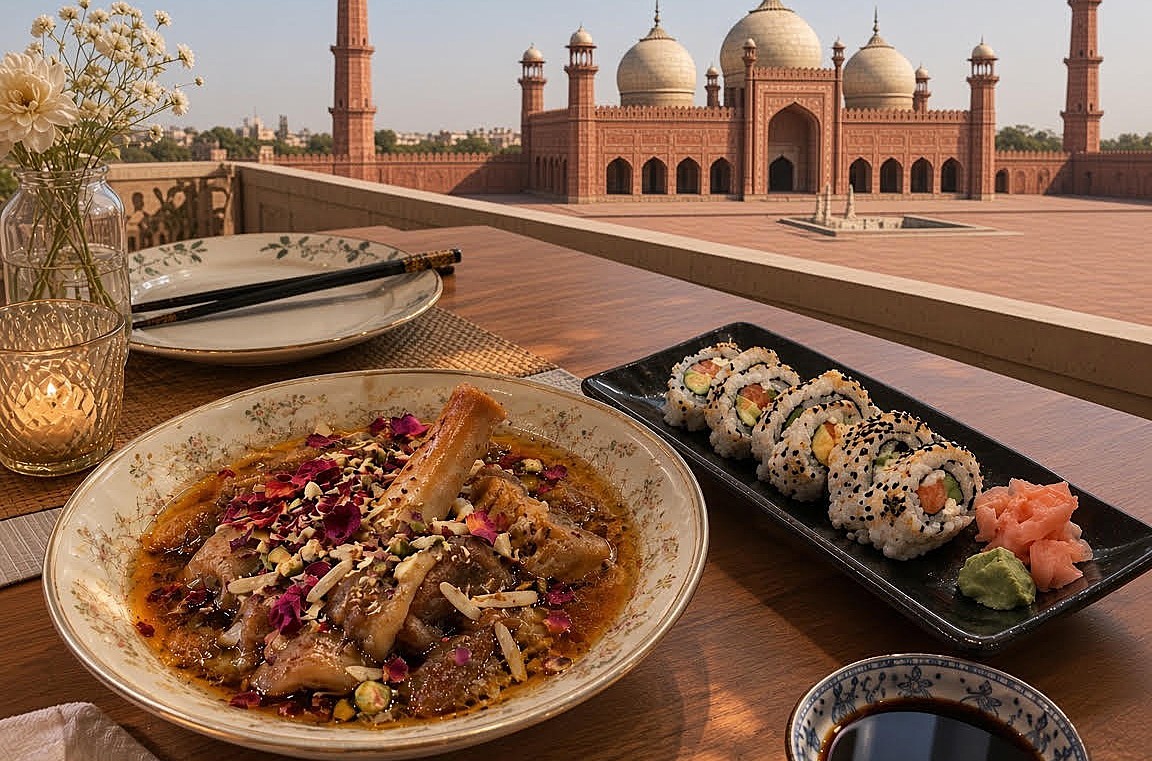
On any given weekend in DHA, a family passes around a platter of Arabian mandi while the table next to them slurps ramen. A decade ago, both would have been hard to find in Lahore. Today, they sit alongside ‘Nihari’ on the city’s growing menu.
Lahore is no longer known only for its popular traditional dishes like Siri Paye, Nihari and Chicken Tikka Masala.
With Arabian Mandi and Japanese sushi finding a place on restaurant menus, Lahorites are increasingly developing a taste for global cuisine — and the city’s culinary identity is expanding rather than being replaced.
“It is now becoming the desi-global food capital of Pakistan,” says Aamir Rafiq Qureshi, chairman of the Pakistan Restaurants Unity Association.

Qureshi is careful to frame the shift as growth, not erasure of customs and traditions in one of the most culturally vibrant cities with a long history of architectural innovation, literary interface and musical mingling.
Lahore’s culinary identity, he says, is not being replaced by outside dishes and recipes — the city’s choices are simply expanding.
A Menu That Keeps Growing
Italian, Turkish, Chinese, Thai, Japanese, Korean and Middle Eastern cuisines are gaining popularity across the city. Burgers, pizzas, pasta, sushi, ramen, Korean fried chicken, mandi and different varieties of kebabs have already found a growing appetite.
Dozens of restaurants specializing in Japanese, Arabian, Turkish, Italian and Chinese cuisines have sprung up in Lahore’s food districts, including DHA, Gulberg, Bahria Town and Johar Town.

Globalizing forces like the internet and social media have made the world smaller, bringing global food cultures right onto people’s screens in their hands — and into their appetites.
Qureshi says sushi has become much more familiar, while ramen and Korean food are attracting growing interest, particularly among younger consumers.
Mandi and Middle Eastern foods, meanwhile, appeal to more consumers because of their rice, meat, spices and sharing culture — they taste more like Pakistani eating preferences.
Travel to Gulf countries, exposure to overseas Pakistanis and social media have all accelerated the trend. Mandi also combines experience, generous portions and group dining, giving it broader market appeal.
From Premium to Everyday
Premium international restaurants naturally attract affluent and upper-middle-class consumers. But when international foods are adapted through reasonable pricing, better portion value, local ingredients, food courts, neighborhood restaurants and delivery services, they become accessible to a much larger middle-class market as well, the PRU chairman told Views News Now.
That expansion has opened new opportunities for chefs and cooks, who are now learning how to prepare foreign cuisines.
“Culinary education has a very important role to play in this transformation. We are exposing our students to international cuisines, culinary techniques and global food cultures,” says Ahmad Shafiq, CEO of the College of Tourism & Hotel Management (COTHM).
The modern chef, he says, must be adaptable and capable of working in different culinary environments.
The growth of international restaurants is creating demand for chefs who understand recipes, ingredients, kitchen operations, food safety, presentation and international standards.

“Our objective is not simply to produce chefs who can cook one particular cuisine. We want to develop versatile culinary professionals who can work anywhere in the world,” the COTHM chief said. It is time, he adds, for young chefs to understand these cuisines professionally rather than simply follow trends.
A Younger Generation, A Wider World
Lahorites are now part of the broader globalizing food culture. Consumers are becoming more adventurous in their cooking and eating preferences, creating exciting opportunities for restaurants, chefs and culinary entrepreneurs — a snowball effect of the evolving cultural and business ethos, according to Shafiq.
He said the transformation is being driven by international travel, social media, food influencers, global exposure and, most importantly, a young generation that is more willing to experiment.
“Today, food is no longer only about satisfying hunger. It is also about experience, discovery, lifestyle and connection with the world,” the COTHM chief says.
In a COTHM training kitchen, a student plates a sushi roll beside a kebab.
Both, increasingly, are Lahore.

Muhammad Luqman is Associate Editor at Views News Now. He writes on wide-ranging issues including economy, South Asia, the Middle East, agriculture, economy and innovation. Luqman has worked some of the leading news organizations and won acclaim for his original and research-based works.