After months of conflict that brought international shipping through the Strait of Hormuz to a near-standstill, energy-laden vessels have resumed transits through the strategic waterway following a peace agreement between the United States and Iran.
“Ships are starting to move, many loaded up with Oil, out of the Strait of Hormuz,” President Donald Trump announced on his Truth Social platform, following the Pakistan-mediated accord reached on Sunday between Washington and Tehran.
The closure of the vital waterway had been a central flashpoint, alongside Iran’s nuclear enrichment program, that upended energy trade amid competing blockades by the U.S. Navy and Iranian forces.
The two longtime adversaries entered direct conflict on February 28, after the U.S. and Israel launched coordinated strikes on Iran. In retaliation, Tehran targeted its oil- and gas-exporting neighbors in the Middle East, accusing them of facilitating the attacks.
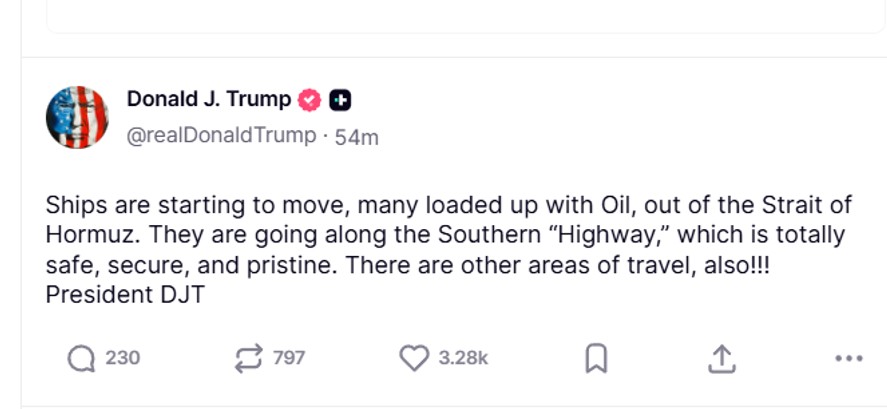
On Monday, Trump reassured shippers that the Hormuz passageway is now safe for international transit.
“They are going along the Southern ‘Highway,’ which is totally safe, secure, and pristine. There are other areas of travel, also!!!”
Global markets rallied on Monday, as the reopening of the Strait of Hormuz eased concerns over energy disruptions and defused geopolitical tensions that had weighed on investor sentiment for months.
US, Iran Reach Pakistan-Brokered Peace Deal; To Sign Agreement on June 19 https://t.co/1Gzb46Z9zd via @ViewsNewsNow
— Views&News (@ViewsNewsMag) June 15, 2026
Asian equities led the gains hours after the announcement: a regional stock index climbed more than 3%, while Japan’s Nikkei 225 headed toward a record close. S&P 500 futures rose 1.1%, and the U.S. dollar softened against major currencies. Bitcoin advanced to its highest level in nearly two weeks.
Oil prices tumbled as traders priced in the prospect of uninterrupted Middle Eastern exports. Brent crude fell more than 4%, toward $83 a barrel, while the U.S. benchmark West Texas Intermediate dropped 5.5% to around $80.
The agreement, facilitated by Pakistan and Qatar, marks a significant step toward ending a conflict that has claimed thousands of lives, disrupted global trade, and stoked market volatility since late February.
Analysts said the restoration of oil flows through the Strait of Hormuz could remove much of the geopolitical risk premium embedded in crude prices, potentially easing inflationary pressures worldwide.
President Trump announced that the Strait of Hormuz would officially reopen on Friday following the signing.
The deal was first disclosed by Pakistani Prime Minister Shehbaz Sharif, then confirmed by Trump and Iranian state media. While the full text has not been released, the broad framework had been circulating among diplomats in recent days.
Global Stocks Surge and Oil Tumbles as US-Iran Peace Deal Calms Markets
“Following intensive talks, we are pleased to announce that the Peace Deal between the United States of America and Islamic Republic of Iran has been REACHED,” Sharif said in a post on X, noting that Pakistan had served as a mediator between the two countries. “The official signing ceremony will be on Friday, 19 June in Switzerland,” he added.
President Trump confirmed the deal soon after Sharif’s announcement. In a Truth Social post, the president said: “The deal with the Islamic Republic of Iran is now complete.”
Investors viewed the breakthrough as favorable for both growth and inflation. Lower energy prices are expected to ease pressure on central banks, raising the likelihood of interest rate cuts and supporting equities and bonds.

Kiran Asim is a writer who covers the U.S., Europe, South Asia, and the Middle East. Her reports and analyses look at the geostrategic issues and contemporary developments and their economic and political implications. She also writes about society and education.