A sweeping peace framework, reportedly agreed to by Ukraine under immense pressure, could deliver a painful conclusion to the war in Europe.
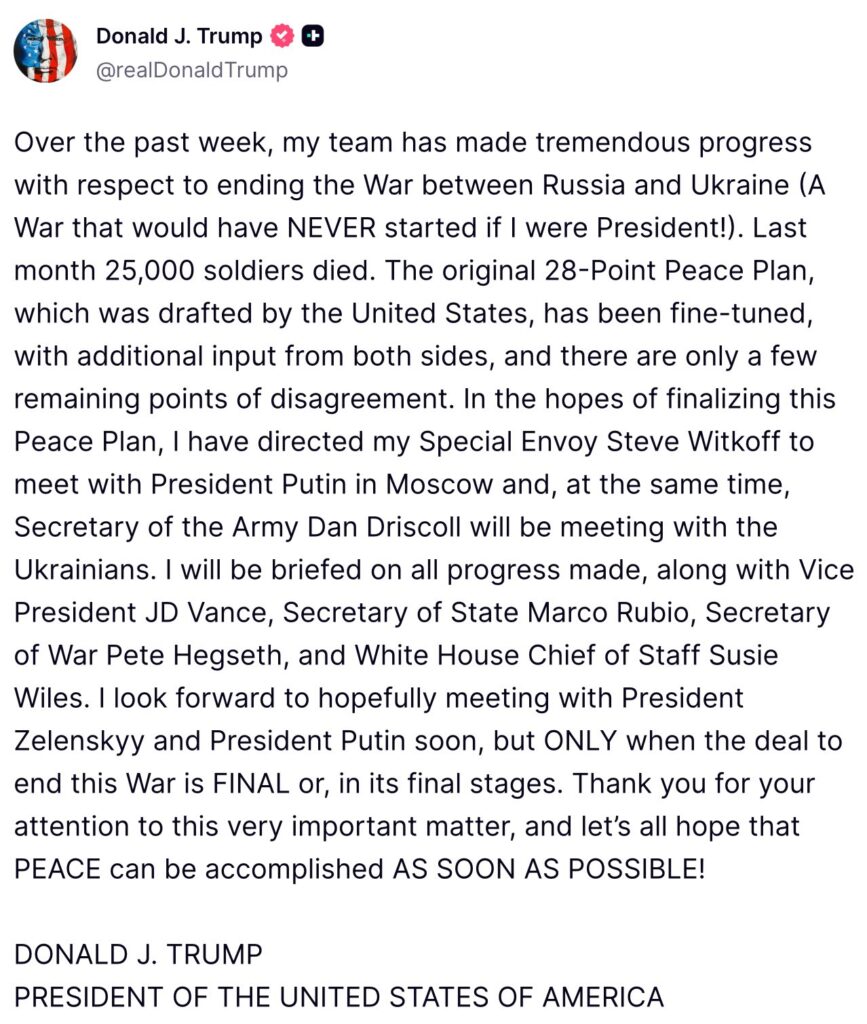
The United States says it has incorporated Ukraine’s proposals into President Donald Trump’s initial 28-point plan after talks in Geneva. However, it is not clear at this point what will be the definitive shape of the agreement that all parties finally agree to.
The latest U.S. diplomatic initiative coincides with a tough predicament for Ukraine and Europe in the four-year-old war as Russian President Vladimir is in a position where he can continue to escalate the pressure on Ukraine and avert pressure from NATO allies.
“This plan comes at the worst time for Ukraine and its partners, as the sanctions bill in the U.S. Congress finally makes some progress after months of waiting, and simultaneously, the Europeans engage in much more serious deliberations on the use of frozen Russian assets in the coming months,” Liana Fix, a senior fellow for Europe at the Council on Foreign Relations, wrote in a brief entitled “Is Trump’s Ukraine Peace Deal a Faustian Bargain?”
Some experts contend the plan will also test the core principles of international law and might even set a dangerous precedent for the 21st century.
The quiet diplomatic corridors of Geneva and Abu Dhabi have yielded a seismic shift in the Ukrainian conflict, far removed from the brutal trenches of the East.
News that Kyiv has accepted the “core terms” of a U.S.-brokered peace initiative has generated mixed feelings of hope and fear. The global capitals are following the development closely while Western leaders are now grappling with the unpalatable price of ending Europe’s largest land war since 1945.
While the final agreement is still being worked out and would likely be agreed in the coming weeks, Kyiv’s agreement meets President Trump’s Thanksgiving deadline.
Ukraine War: US sanctions Russia’s oil giants, key suppliers to China and India
Generally, experts see little prospects of the Ukraine war ending on equal terms Specifically, Ukraine and European experts see the demands for Ukraine to give up territory under its control and commit to not joining NATO alliance as hard pills to swallow.
The original plan proposed that Ukraine should make a series of territorial concessions, namely recognition of Crimea, Luhansk, and the Donetsk region as parts of Russian.
However, one proposal gives a reprieve to Ukraine – that it is able to at least maintain a sizeable military force.
In a point-by-point analysis of the proposal expert – Mark F. Cancian, a senior adviser with the CSIS Defense and Security Department, and Maria Snegovaya, a senior fellow for Russia and Eurasia with the Europe, Russia, and Eurasia Program at the Center for Strategic and International Studies – note that this U.S. provision softens Moscow’s key previous demand that Ukraine be disarmed.
“Although many commentators have taken this provision as a significant restriction on Ukraine, the reduction will not be a problem for Ukraine to implement. With a ceasefire, it will want to demobilize some of its forces, now estimated at 880,000, and will likely end up below 600,000. Before the war, the Ukrainian armed forces totaled only 209,000 active-duty personnel.”
However, Russia will still likely want some specificity about what is included in the 600,000 to prevent Ukraine from indulging in creative accounting, they wrote.
Though in flux, the plan has been described as pragmatic surrender to political and military exhaustion at a time when Washington eagerly wants to achieve a ceasefire in the war.
Rep. McCaul: Zelenskyy Must Insist on Article-5-Like Security | https://t.co/bFDK4tj2dm
I 100% agree with my friend @RepMcCaul. https://t.co/ITwYCG2Y3W
— Rep. Don Bacon 🇺🇸✈️🏍️⭐️🎖️ (@RepDonBacon) November 25, 2025
If concluded one-sidedly, the plan may appear like a blueprint for a restructured geopolitical reality that appears to favor the aggressor.
For President Volodymyr Zelenskyy, signing such a deal means trading national unity for national survival. It risks igniting widespread domestic backlash, potentially fracturing the fragile political consensus that has sustained the nation through nearly four years of war.
For the international community, a lopsided framework may set a dangerous precedent that territorial gains achieved by blatant military invasion can be internationally ratified.
The question many experts are asking is if the core principle of post-WWII security—that borders cannot be changed by force—would stand firm or be weakened.
Chris Van Hollen: Trump administration throwing Ukrainians ‘under the bus’ https://t.co/Wtq6IQ7y5o
— The Hill (@thehill) November 25, 2025
Equally transformative is the provision that Ukraine must permanently renounce its ambition to join the NATO alliance. This clause delivers Moscow a critical, long-sought strategic victory, ensuring in its view a neutral buffer state and effectively curtailing NATO’s eastward expansion.
In exchange, Ukraine is set to receive a package of “security assurances” from the guarantor nations. This is where the deal’s credibility faces its greatest test.
These assurances, no matter how strongly worded, are a stark contrast to NATO’s binding Article 5 collective defense pledge. They represent a diplomatic commitment, not an automatic military one, as per the current interpretations of the plan. Future Kyiv leaders will find their nation’s long-term security dependent on the political will of individual capitals, rather than the ironclad treaty obligations of an alliance.
For Europe the agreement undermines the principle of strategic autonomy. European allies, particularly those on Russia’s border, have watched the U.S.-driven negotiations with a mix of relief over the prospect of peace and profound anxiety over the lack of full consultation.
Surely, the signing of the final agreement – still in works -will bring the world a sigh of relief.
But it will also come with a looming question about prospects of territorial integrity and sovereign choice of nations being under attack.
It remains to be seen if the final accord will be a triumph of diplomacy or a function of geopolitical reality, prioritizing the immediate cessation of violence over the long-term defense of international principles?

Kiran Asim is a writer who covers the U.S., Europe, South Asia, and the Middle East. Her reports and analyses look at the geostrategic issues and contemporary developments and their economic and political implications. She also writes about society and education.