
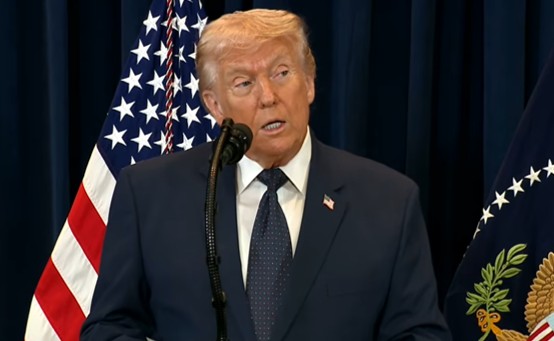
U.S. President Donald Trump said the United States and Iran have held “very good and productive” discussions in recent days, signaling a possible diplomatic opening even as tensions remain high in the Middle East with recent American warning of attacks on Iranian power plants and Tehran’s threat of retaliation.
Trump also announced in a Monday morning social media post that the U.S. has postponed strikes against Iran’s energy infrastructure for five days.
In a statement, Trump said the talks focused on achieving a “complete and total resolution” of ongoing hostilities, adding that further discussions are expected to continue throughout the week.
Citing the “constructive” nature of the engagement, Trump said he has directed U.S. authorities to postpone planned military strikes against Iranian power plants and energy infrastructure for a five-day period.
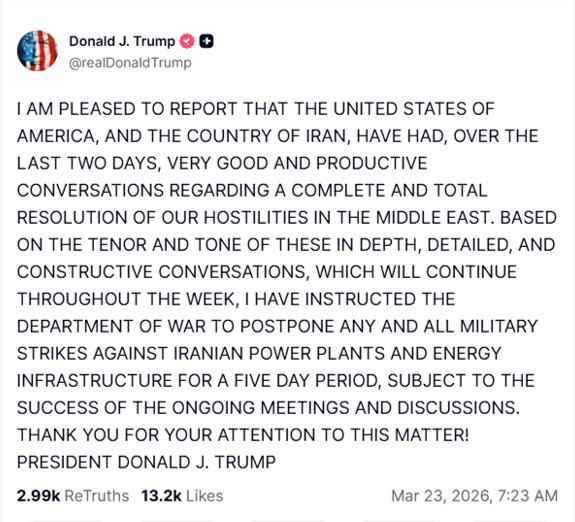
The pause, he noted, is conditional on the progress of ongoing negotiations. Trump had earlier announced a large, coordinated military operation with Israel against Iran on February 28.
“Based on the tenor and tone of these in-depth, detailed, and constructive conversations, which will continue throughout the week, I have instructed the Department of War to postpone any and all military strikes… for a five-day period,” Trump said on his Truth Social platform.
The announcement marks a potential shift from earlier rhetoric that had indicated possible escalation and suggests Washington may be exploring a diplomatic pathway to de-escalate the crisis.
Tehran has retaliated against U.S. and Israeli strikes on the country with a series of attacks on U.S. military bases and energy infrastructure in the Middle Eastern countries including the United Arab Emirates, Qatar, Kuwait and Saudi Arabia.
Iranian Missile Lands Near Dimona as Tehran Reports Strike on Natanz Nuclear Site
However, it remains unclear whether the talks will lead to a sustained breakthrough, as both sides have recently exchanged threats, raising the risk of wider repercussions for energy markets, the global economy, and stability in the region.
The conflict has already sent shockwaves across global markets, with fuel prices rising sharply amid strikes and counterstrikes targeting key oil and gas infrastructure.
Now into its fourth week, the conflict has seen 1,500 people killed in Iran, more than 1,000 in Lebanon, 15 in Israel. The U.S. military has reported deaths of 13 members.
Meanwhile, Iran’s Fars and Tasnim news organizations reported there had been no talks between Washington and Tehran.
🚨 BREAKING: Iran speaker named in Axios report says “no negotiations” taking place with U.S. in fresh posts
Iran’s parliament speaker Mohammad Bagher Ghalibaf – identified in Axios reporting as a key figure in alleged backchannel talks – said moments ago on X that “no… https://t.co/ILywe6Amb9
— Drop Site (@DropSiteNews) March 23, 2026
Later, speaking to reporters Trump said he believes Iran is strongly inclined toward reaching an agreement, suggesting there is a “real possibility” of a deal emerging from ongoing discussions.
Before boarding Air Force One in Florida, Trump indicated cautious optimism, noting that while he would “bet” on a deal being reached, no outcome is guaranteed at this stage.
The president outlined what such an agreement could entail, emphasizing that the United States would seek to take control of Iran’s enriched uranium as part of any arrangement with Iran.
President Trump provides an update on negotiations with Iran.
“They want very much to make a deal. We’d like to make a deal, too.” – President Donald J. Trump 🇺🇸 pic.twitter.com/amrrYVfPet
— The White House (@WhiteHouse) March 23, 2026
He described the process as straightforward if an agreement is finalized, signaling a firm U.S. position on limiting Iran’s nuclear materials.
“It’s very easy, if we have a deal with them, we’re going down and we’ll take it ourselves,” Trump said.
“We want to see, no nuclear bomb, no nuclear weapon. Not even close to it,” he added.

Ali Imran is a Washington-based journalist, who has worked for leading world news organizations as a correspondent, expert and in editorial positions. He is a published author and poet.







This sounds like encouraging news. Let us hope it leads to genuine de-escalation and not just a temporary pause. Past announcements have raised hopes but were followed by conflicting actions, so a degree of caution is understandable. One hopes that this time, dialogue will prevail over further escalation.