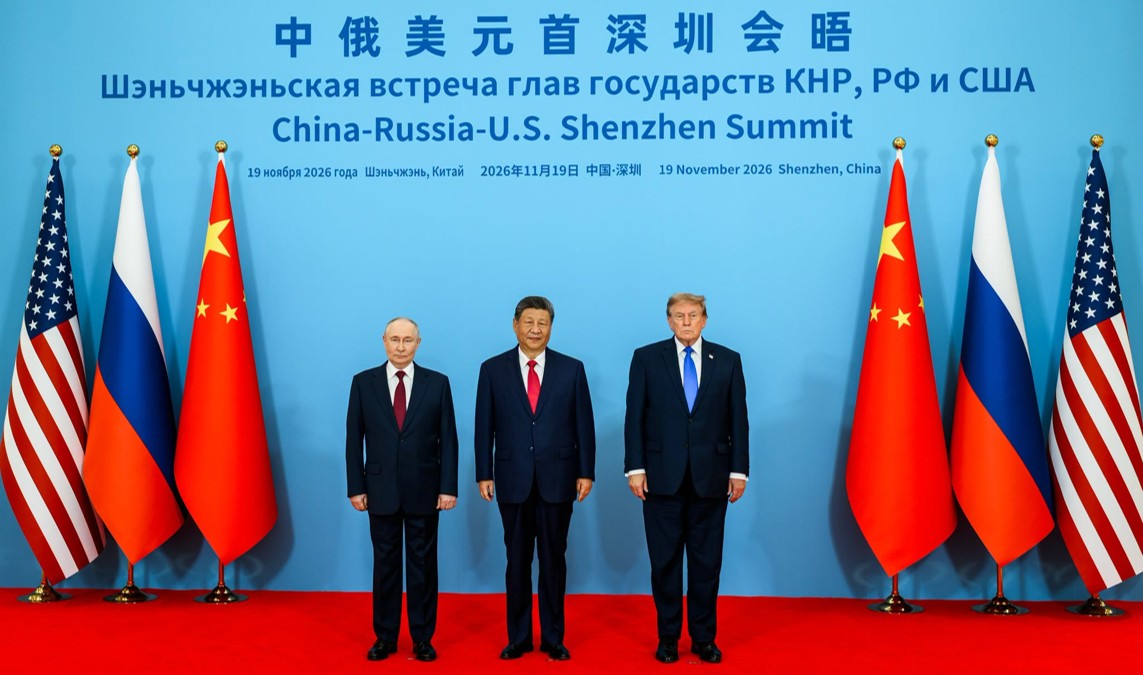
President Donald Trump, Chinese President Xi Jinping and Russian President Vladimir Putin gathered at Kylin Villa in Shenzhen on Thursday for a historic trilateral meeting, with the US leader describing the engagement as charting a “different course” in foreign policy by pursuing direct dialogue with strategic rivals.
The first-ever meeting of the leaders of the world’s three largest nuclear powers took place against a backdrop of global conflicts, mounting geopolitical tensions and trade disputes.
Standing before the flags of their respective countries, the three leaders posed for a photograph before entering the main meeting room.
Xi described the gathering as groundbreaking. “This is the first time the heads of nations from China, Russia, the US meet, it has groundbreaking significance,” he said, according to the Chinese news agency Xinhua.
Earlier in the day, Trump held separate bilateral meetings with both Putin and Xi. He told Xi that their strong personal relationship benefited people in both the United States and China, while referring to Putin as a friend.
Trump Sees a New Path
Adopting a notably cordial tone towards both leaders, Trump argued that direct engagement with countries considered adversaries could produce results, even where significant differences existed.
“As presidents of three of the world’s largest countries, we have a special responsibility to maintain open, respectful and productive dialogue on issues impacting not just our people, but the entire planet,” he said at the start of the talks.
President Trump calls trilateral meeting with Chinese and Russian presidents historic, urging nuclear cooperation between three powers https://t.co/LErlBcWAqJ
— Views&News (@ViewsNewsMag) November 19, 2026
He argued that previous leaders had too often avoided engagement with countries with which they disagreed, saying his administration was pursuing a different approach.
“Too often past leaders avoided talking to nations with whom they had disagreements, and we feel the opposite, and we think that we are sure about that,” Trump said.
He added: “No peace was ever forged by declining opportunities for engagement and speech together. We are choosing a different course.”
Trump maintained that refusing to engage with countries over their differences had never helped resolve international problems, underscoring his belief that dialogue could open the way for diplomatic progress.
Nuclear Arms and Ukraine on the Table
Nuclear arms control featured prominently on the agenda, although Trump acknowledged the difficulties involved in reducing nuclear arsenals.
“Once you have the nuclear weapons, it’s very hard to not have them,” he said. “It’s the way life works.”
The issue carries particular significance following the expiration of the New START treaty, the last major nuclear arms-control agreement between the United States and Russia. Trump’s interest in bringing China into future arms-control arrangements also presents a significant challenge, given the differences between the three countries’ nuclear arsenals and strategic priorities.
Iran also figured as a key contemporary issue and an important part of the broader geopolitical context of the meeting. Trump’s discussions with Xi and Putin took place against the backdrop of the ongoing conflict involving Tehran, concerns over Iran’s nuclear program and the implications for regional security and global energy supplies. Trump said the United States and China shared an interest in ensuring the uninterrupted flow of energy through the Strait of Hormuz and preventing Iran from acquiring nuclear weapons.
Trump also voiced optimism that an end to the war in Ukraine might be approaching.
“I think things are happening. I think that (Putin) and I hope the other side would like to see an end to that war,” he said.
Before the press was dismissed and the closed-door session began, Trump added: “Let’s see if we can get something done.”
The Ukraine conflict remained a significant point of disagreement. Although Putin said he had discussed the war with both Trump and Xi, Ukraine was not represented at the trilateral meeting, raising questions about the limitations of negotiations among major powers when the country directly affected by a conflict is absent.
The leaders also discussed wider international security concerns, including Iran and the disruption of oil supplies through the Strait of Hormuz.
Trade Wars, Technology and the Jensen Huang Controversy
The meeting also took place against the backdrop of continuing trade and technology tensions between Washington and Beijing. The two countries have been locked in a prolonged tariff dispute since Trump’s return to office in 2025, with successive rounds of tariffs and retaliatory measures at one point pushing additional duties on each other’s goods as high as 125 per cent.
Although the two sides subsequently reached a trade truce and agreed to reduce some tariffs, significant disagreements remain over market access, rare-earth supplies, technology transfers and China’s access to advanced U.S.-made semiconductors. The truce was extended for another two months in November, providing a temporary reprieve but leaving the broader trade relationship unresolved.
Advanced artificial intelligence chips have emerged as a particularly contentious issue. Washington’s restrictions on semiconductor exports to China reflect growing concerns over the potential military and strategic applications of advanced computing technology, while Beijing views such restrictions as part of a wider effort to contain China’s technological development.
The tensions have been further complicated by the controversy surrounding Nvidia founder and former chief executive Jensen Huang, whose resignation on November 12 has intensified scrutiny of the company’s China business and U.S. semiconductor export controls.
.@POTUS boards Air Force One and prepares to head home after a historic trip to China and the Philippines.
This week, @POTUS announced $17B+ in deals for U.S. companies in Manila and held landmark meetings with President Xi and President Putin in Shenzhen.
He never stops working for the American people. 🇺🇸
— Rapid Response 47 (@RapidResponse47) November 19, 2026
Huang’s departure followed revelations about his personal relationship with Alice Huang, a former executive at Singapore-based cloud computing company Megaspeed, whom US officials reportedly suspect of having links to Chinese intelligence. Allegations that the company was involved in diverting advanced Nvidia chips to China have also drawn scrutiny. However, the allegations have not been established, and Singaporean authorities have said their investigation did not concern espionage.
The controversy became an unexpected issue during Trump’s meeting with Xi when Bloomberg reporter Annmarie Hordern asked the US president whether Huang had been “disloyal to the United States”.
Chinese officials subsequently barred the journalist from attending the trilateral meeting, despite efforts by White House officials to have her reinstated.
The episode highlighted how deeply technology competition, national security concerns and political sensitivities have become intertwined in US-China relations, even as Trump seeks to project a more cooperative relationship with Xi.
Third US Aircraft Carrier Enters Middle East as Tensions with Iran Persist
Xi and Putin Stress Shared Responsibility
In his opening remarks, Xi said the three countries should work together to address global challenges and maintain international stability.
“China, Russia and the United States should set an example in cooperating to meet global challenges, jointly maintain world peace and stability, and make greater contributions to human progress,” he said.
Putin similarly emphasized the shared responsibilities of the three powers in maintaining international peace and security.
He noted that Russia, China and the United States “have numerous shared interests in the settlement of regional conflicts, including obviously the conflict in Ukraine,” an issue he said he had discussed with Xi on Wednesday and with Trump on Thursday.
“I am convinced that Russia, the US and China, our people are capable of making a significant contribution to strengthening peace and stability over the world, if we cooperate constructively on the basis of mutual respect, equality, and a balance of interests,” Putin said.
The emphasis by Xi and Putin on cooperation, mutual respect and equality also reflected their preference for a greater role in shaping international affairs and global security arrangements.
Following the meeting, the three countries outlined areas for further cooperation in a declaration, including nuclear risk reduction, United Nations reform and increased supplies of petroleum products. However, the declaration did not resolve the major differences over Ukraine and Iran, and the gathering produced no major diplomatic breakthrough.
Trump Plays Down Nvidia Co-Founder Controversy as US-China Trade Tensions Draw Global Attention
The Immediate Takeaway
The Shenzhen meeting marks the first-ever trilateral gathering of the leaders of the United States, China and Russia, bringing together the world’s three largest nuclear powers at a time of heightened geopolitical tensions. Its significance lies not only in the opportunity for direct dialogue but also in the possibility of establishing channels for cooperation on nuclear risks, arms control and other international security concerns.
The meeting represents a U.S. attempt to pursue a different diplomatic approach, based on direct engagement with strategic rivals rather than allowing disagreements to prevent dialogue.
Trump’s emphasis on personal relationships with Xi and Putin reflects his belief that communication at the highest level can create opportunities for progress on issues such as nuclear arms control and Ukraine.
Xi and Putin, meanwhile, used their opening remarks to emphasize the shared responsibilities of the three powers in maintaining international peace and stability. Their references to mutual respect, cooperation and equality also signal their interest in a more prominent role in shaping the international order.
The American envoys said that in Berlin, during our meetings tomorrow, they would give us a debrief on the talks the American President is currently holding in China. We will also be hearing from our partners currently in China.
We and the Europeans have a clear, shared position: issues concerning Ukraine must be decided with Ukraine’s participation, and issues concerning Europe must be decided with Europe’s participation. This is the only approach there can ever be.
Thank you to everyone who is helping and who is pushing for a strong agenda to bring this war to an end.
— Volodymyr Zelenskyy / Володимир Зеленський (@ZelenskyyUa) November 18, 2026
However, significant obstacles remain. Nuclear arms reductions involving three countries present a far greater challenge than the traditional bilateral framework between Washington and Moscow. The expiration of the New START treaty, combined with China’s expanding nuclear capabilities and its reluctance to be drawn into arrangements based on existing US-Russian models, further complicates the prospects for a broader agreement.
In the global context, the Iran and Ukraine conflicts hang as major issues with disagreements. On Ukraine, there is limited evidence so far that Beijing is prepared to exert significant pressure on Moscow to end the conflict.
The absence of Ukraine from the discussions also raises questions about the limitations of negotiations among major powers when the country directly affected by a conflict is not represented.
Trade and technology competition between Washington and Beijing, meanwhile, continues to be shaped by competing economic and domestic priorities. The fragile trade truce, disagreements over semiconductor exports and the controversy surrounding Nvidia illustrate how difficult it will be to separate economic cooperation from broader strategic rivalry.

Kiran Asim is a writer who covers the U.S., Europe, South Asia, and the Middle East. Her reports and analyses look at the geostrategic issues and contemporary developments and their economic and political implications. She also writes about society and education.

Ali Imran is a Washington-based journalist, who has worked for leading world news organizations as a correspondent, expert and in editorial positions. He is a published author and poet.