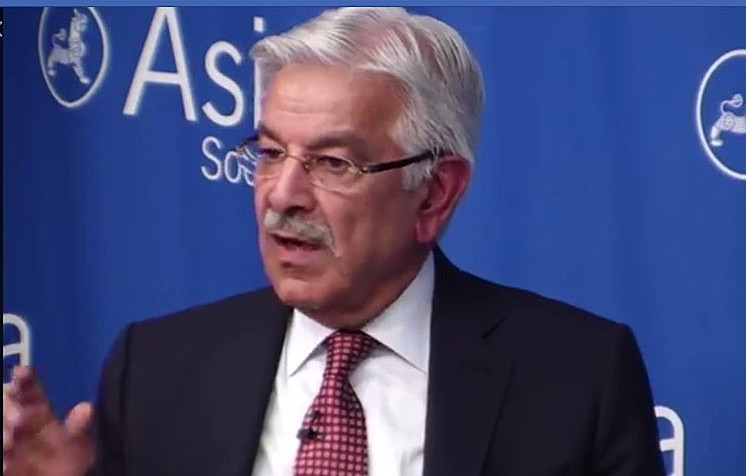
Pakistan has explicitly warned Yemen’s Houthi rebels that the tripartite Makkah Defense Alliance with Saudi Arabia and Turkiye could trigger collective military reprisals if their cross-border attacks against the Kingdom continue or escalate.
Defense Minister Khawaja Asif declared there should be no second guessing on the alliance’s retaliation if a member country gets attacked.
Pakistan, a major military and nuclear power in South Asia and the Middle East, has already deployed military assets in Saudi Arabia that include fighter jets, thousands of troops and missiles.
“There is no ambiguity,” he stated as per comments reported by Dawn newspaper while emphasizing that the agreement stipulates “aggression against one party was equivalent to aggression against all.”
🇵🇰🇹🇷🇾🇪 Pakistani officials have arrived in Istanbul, to discuss what comes next after another round of Houthi strikes on Saudi Arabia…
And airstrikes are now on the table.
Reports earlier today said Saudi had asked Pakistan to hit Houthi positions in Yemen, with Islamabad… pic.twitter.com/igSw3uSGTN
— Mario Nawfal (@MarioNawfal) September 9, 2026
He further declared: “We are bound by the terms and conditions of this pact and we will honor them in case there is a need.”
Asif’s comments came after the Houthis claimed responsibility for missile and drone strikes on four Saudi cities—which wounded 73 people and set oil installations ablaze—Asif made clear that the August 7 defense pact is not a diplomatic formality.
“This is a joint defense pact,” he noted, speaking on Pakistani Geo News channel.
“And unprovoked aggression or spillover of whatever is happening in Yemen into Saudi Arabia, definitely, the pact will become operational; there should be no doubt in this.”
The defense minister expressed hope that the situation would “come under control and die down.
Otherwise, he had a pointed warning to the Houthi leadership.
Pakistani Defense Minister Asif on the Türkiye-Saudi Arabia-Pakistan defense agreement:
Ultimately, terrorism is one major threat to all three countries. You are absolutely right that the Houthis’ activities also pose a threat to Saudi Arabia.
Similarly, in one form or… pic.twitter.com/g9Qly0tuVU
— Clash Report (@clashreport) August 8, 2026
Islamabad is one of the three founding members of the Makkah Alliance, which recently indicated it was open to expansion.
At the same time, Pakistan has been a key mediator in the U.S.-Iran conflict, and was instrumental in brokering the process that led to an interim peace deal between Washington and Iran in June.
In his remarks, Asif also made a distinction between the Yemeni government and the Iranian-backed militant group, saying the Houthis are rebels, “non-state actors” and that Yemen’s government had already responded to their attacks.
He also observed that while “there is sympathy for Iran around the Muslim world… exploitation of a bilateral dispute by non-state actors, I believe they are doing it at their own peril.”
Asif stressed that the alliance is fundamentally deterrent in nature, not offensive, noting that the three countries “did not need to respond to aggression with aggression,” but held that the member states had established their respective strengths.
He also reaffirmed Pakistan’s longstanding commitment to Saudi security, recalling his 2014 visit to Yemen during earlier hostilities: “At that time too, we helped Saudi Arabia,” he said, adding that the two nations’ ties and the “sanctity” of the Gulf country’s land “warrant that whenever there are testing times, we help them.”
On peace prospects in the Gulf, where the U.S. and Iranian forces have renewed strikes against each other, the defense minister struck a measured tone regarding U.S.-Iran negotiations, refusing to declare them dead.
“I will not abandon hope that the process has ended or that all doors have closed. There is a stalemate, but I will say the situation is better than that,” he said, noting there was “indirect engagement.” He acknowledged that Pakistan walks a tightrope given its “brotherly relations” with countries on both sides of the conflict.
However, Asif offered a stark warning about Israeli interests, suggesting Tel Aviv benefits from prolonged Gulf instability. “Israel will want that the conflict should continue and (Gulf) countries should be drained,” he said, pointing out that Israel was not incurring any expenses in the war.
Pakistan’s civilian and military leadership has uniformly condemned the Houthi attacks. Prime Minister Shehbaz Sharif pledged “steadfast support for the kingdom’s sovereignty, security and territorial integrity,” while the Foreign Office issued a strong statement denouncing the “reprehensible” strikes.

Asim Tanveer is a seasoned journalist working for TV and electronic and print media outlets. He has been working for some of the world’s leading news organizations including Associated Press (AP), Reuters, BBC, CNN, CNBC, Star TV, Voice of America and The New York Times for more than 20 years. He has won several awards for his live coverage of events that include a Reuters News Agency World Award and the Pride of Performance award in 2010.