Punjab province faces dangerously high floods amid an unusually long monsoon season and massive water releases from India, threatening lives, crops, and infrastructure in the region.
The sudden discharge has pushed a powerful surge of over 210,000 cusecs of water into Pakistani territory through Kot Ninan, triggering widespread flooding and panic. Local government officials in Punjab’s eastern districts said the current waterflow is the highest in more than a decade.
According to the Provincial Disaster Management Authority (PDMA), water levels in both the Ravi and Sutlej rivers have risen to dangerously high levels, prompting mass evacuations across multiple districts.
Authorities warn that the next 24 to 48 hours could see a “very high flood” inundating Jassar, Shahdara, and Head Baloki, placing Lahore and surrounding areas under severe threat.
According to NDMA, in district Sialkot at Head Marala, 932,000 cusecs of water coming from India is passing through the Chenab River.
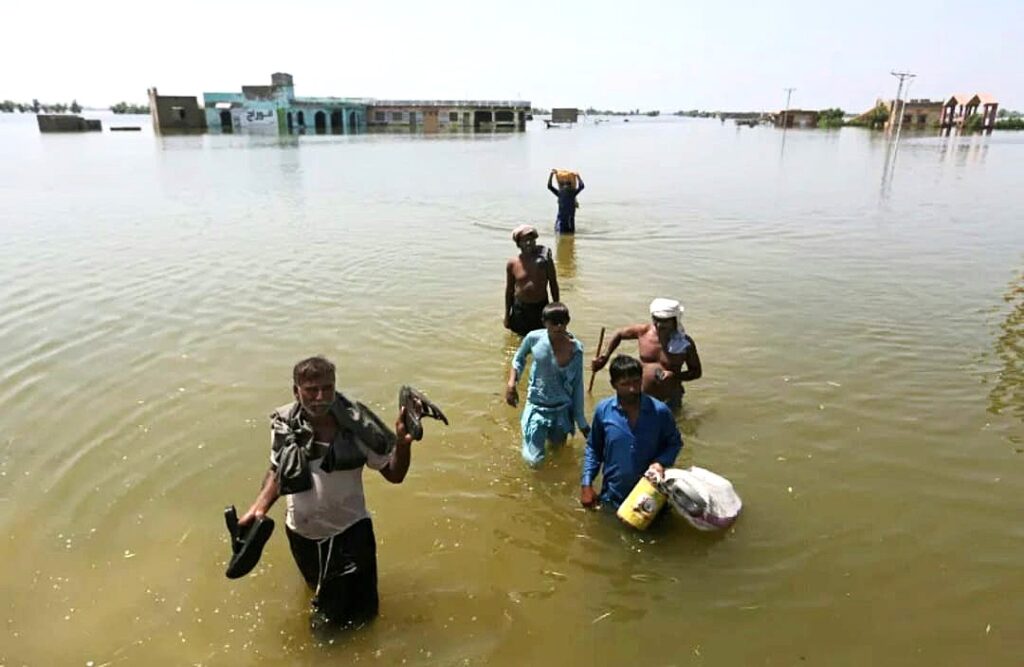
River Swell Intensifies at Jassar, where water inflow has surpassed 200,000 cusecs while at Kot Ninan, it has surged beyond 250,000 cusecs.
The Sutlej River near Kasur is experiencing an extreme flood, with water flow exceeding 208,973 cusecs and still rising.
In light of the rapidly escalating situation, the PDMA has ordered immediate evacuations of all housing societies and settlements along riverbanks. The Pakistan Army has been deployed to the worst-hit areas including Kasur, Sialkot, and Narowal to support relief and rescue operations.
In Sialkot, Deputy Commissioner Sabah Asghar Ali declared August 27 a local holiday and announced the closure of all educational institutions. Additional emergency measures include evacuation of all low-lying and flood-prone areas.
Commissioner Gujranwala Naveed Haider said in Sialkot, Narowal, Pasrur, and Gujranwala, people are being evacuated from flood-hit areas to safe locations late into the night.
During the past 24 hours, stormy rains have worsened the situation in Gujranwala Division. According to the Meteorological Department, 445 millimeters of rainfall was recorded in Sialkot and surrounding areas in just 12 hours.
Army has been requisitioned to assist district administration in Lahore, Kasur, Sialkot, Faisalabad, Narowal, and Okara.
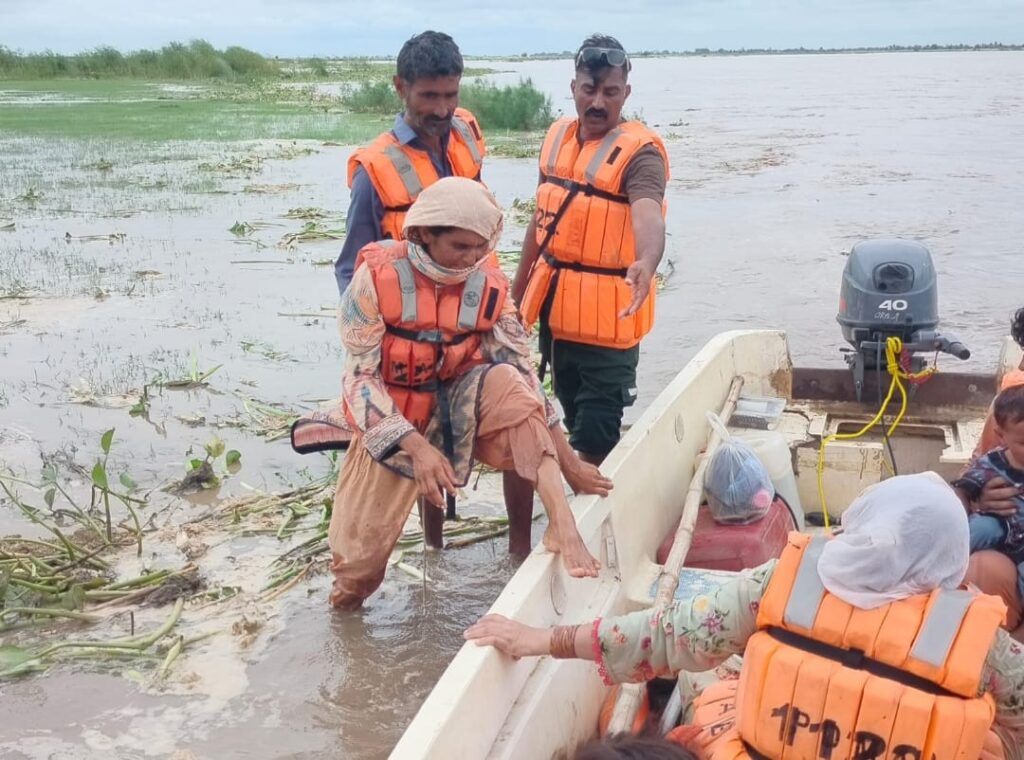
The local administration has imposed Section 144 to limit public access near rivers and streams and citizens are being urged to stay indoors and avoid unnecessary travel.
In Pasrur Tehsil, floodwaters have breached residential zones, severing road connections between the town and neighboring villages, isolating several communities.
Data from the National Disaster Management Authority (NDMA) confirms that nearly 150,000 people have already been evacuated to safety.
Officials note that 40,000 people evacuated promptly after the first alerts were issued.
The current crisis underscores Pakistan’s increasing vulnerability to climate change impacts. A combination of monsoon rains, glacial melt, and sudden dam discharges has led to extreme flooding scenarios that are becoming alarmingly frequent.

Punjab Province Faces Dangerously High Floods
Chief Minister Maryam Nawaz has issued strict directives for early evacuation of all communities in flood-prone zones. The Ministry of Climate Change has also warned of intense rainfall in Gujranwala, Gujrat, and Lahore divisions, heightening the risk of both riverine and urban flooding.
The Pakistan Meteorological Department has forecast heavy downpours over the upper catchment areas of the Ravi, Sutlej, and Chenab rivers, which are expected to worsen flood conditions over the coming days.
Meanwhile, Indian authorities are facing criticism from Pakistani officials and civil society for allegedly releasing water from all floodgates of the Thein Dam without adequate coordination or prior warning. Many see it as a reckless move that disregards humanitarian consequences.
As water levels continue to rise and floodwaters spread, Punjab remains in a state of high alert. The military, NDMA, PDMA, and Rescue 1122 are working around the clock to manage the crisis. However, with infrastructure under immense pressure, thousands displaced, and more rainfall forecast, the threat is far from over.
The people of Punjab now face the possibility of one of the most devastating flood events in recent memory.
Follow for more: Twitter (X) | Facebook | Instagram | LinkeIn

Kiran Asim is a writer who covers the U.S., Europe, South Asia, and the Middle East. Her reports and analyses look at the geostrategic issues and contemporary developments and their economic and political implications. She also writes about society and education.